
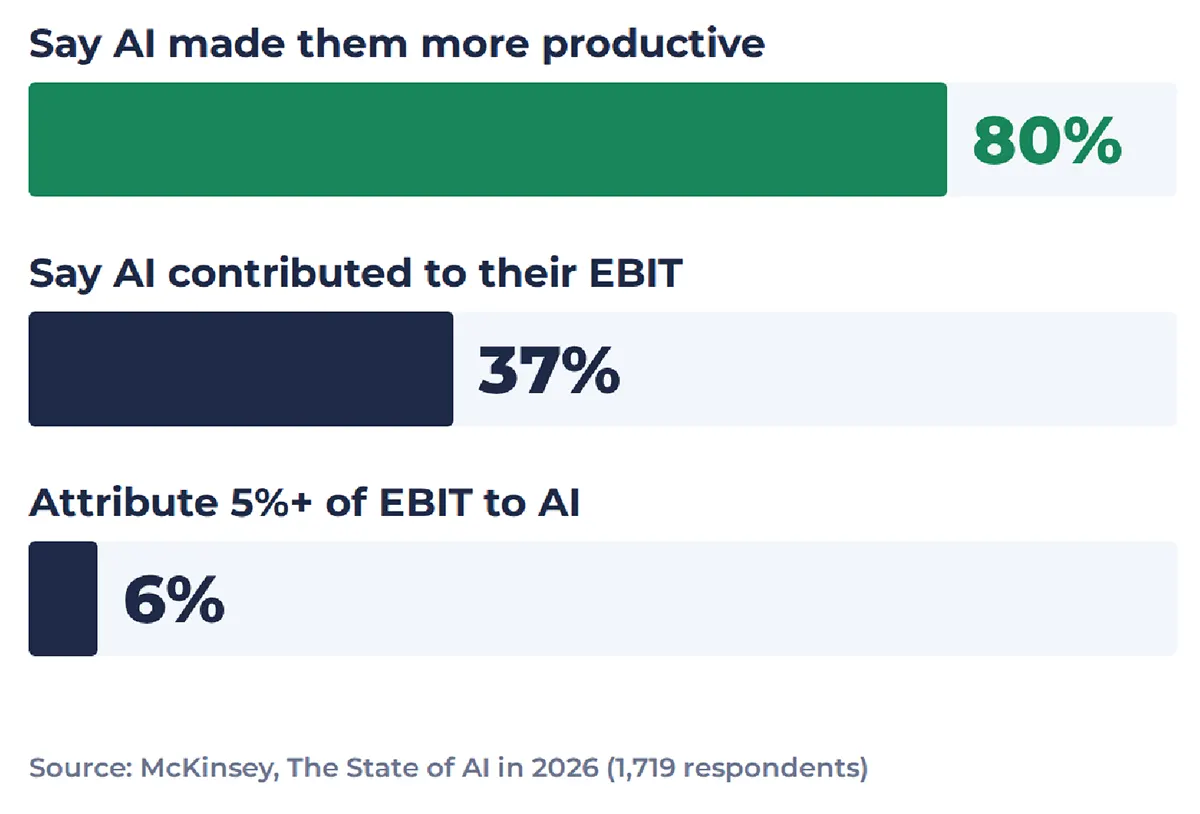
McKinsey's tenth annual State of AI survey, published on August 25, 2026, and based on 1,719 respondents across 97 countries, includes two numbers that don't sit comfortably together. Eighty percent of respondents say AI has improved their individual productivity. Only 37% say AI has contributed anything at all to their organization's EBIT – essentially unchanged from a year earlier. Just 6% clear McKinsey's "high performer" bar of attributing 5% or more of EBIT to AI.
A third number from the same survey explains why this article exists: about one in five respondents report that AI-related operating costs, including token costs, have constrained how much AI they use. McKinsey is careful to call this a meaningful consideration rather than a widespread constraint – 60% still expect to increase AI investment over the next year – but a cost line that changes behavior before anyone has proven the return is the definition of a measurement problem.
So the picture is a technology people can feel working, a cost line that is starting to bite, and a bottom line that has not moved. This article looks at the impact of AI on business in that narrow, practical sense: where the cost shows up first, what the efficiency gains actually cost, how the picture differs by industry, and how to measure it all before the spend gets ahead of the outcome.
We treat "AI impact on business" as a financial and operational question – cost, efficiency, output quality, and operational risk, the things a CFO or a VP of Engineering has to answer for. That is a different question from AI's societal or environmental footprint, which gets most of the headlines and none of the budget scrutiny.
What AI Impact on Business Means
The business impact of AI adoption falls into four measurable categories, and the most common reporting mistake is mixing them.
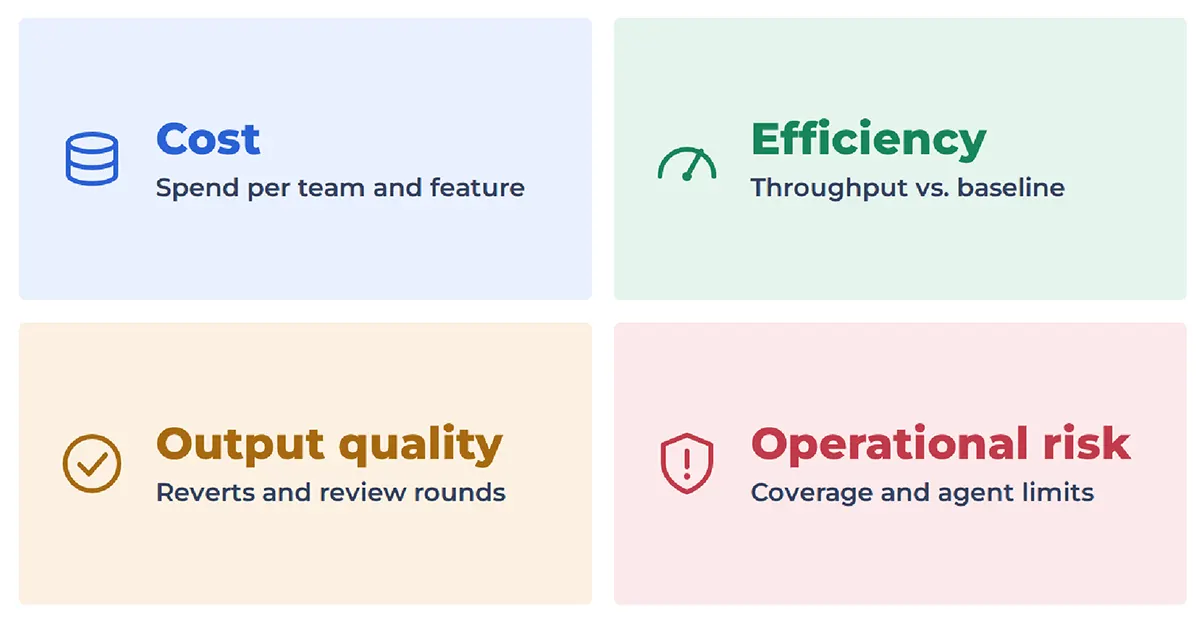
• Cost. The most visible: compute, licensing, integration, and the people running it. Measured as spend per team, per feature, and per environment – not as one monthly total.
• Efficiency. Throughput per dollar or per hour: tickets closed, code shipped, reports produced. Measured against the same team's pre-AI baseline on comparable work.
• Output quality. Accuracy, consistency, and whether AI-assisted work needs less rework than before. Measured as revert rate, review rounds, and defect escape rate.
• Operational risk. The slowest to show up and the most expensive when it does: compliance exposure, model drift, vendor lock-in, and ungoverned AI agents making decisions nobody signed off on.
Operational risk is the category teams most often declare unmeasurable, but it is. It has countable proxies: the share of AI traffic passing through a governed gateway (coverage), the number of registered agents running without cost, time, or recursion limits, the number of models and MCP servers in use without a named owner, and time-to-revoke when access has to be pulled. If none of those numbers exist, the risk is not low. It is unmeasured.
Deloitte's 2026 State of AI in the Enterprise survey, covering 3,235 director-to-C-suite leaders across 24 countries, shows the same activity-versus-outcome gap from another angle: 66% report productivity gains, but only 20% report revenue growth today, while 74% hope to get there.
Where AI Impact on Business Operations Shows Up First: Infrastructure and Compute
Before AI touches a single business outcome, it touches the infrastructure bill. For most companies running AI in production, inference quickly becomes the least predictable cost line. Unlike a fixed SaaS seat license, inference cost scales with usage, model choice, and prompt complexity, which makes it structurally harder to forecast than traditional cloud spend.
The macro picture sets the context. Gartner's July 2026 forecast puts total worldwide IT spending at $6.37 trillion in 2026, up 14.2%, with data center systems – the infrastructure AI models run on – growing faster than any other category, by 62.5% to $822 billion. That figure covers all IT, not AI alone. Gartner's separate May 2026 forecast puts worldwide AI spending at $2.59 trillion in 2026, up 47%, with more than 45% going to infrastructure rather than applications.
As Gartner analyst John-David Lovelock put it: "Building the compute capacity required for AI is the largest infrastructure project ever attempted by humanity."
Most of that spending is vendor and hyperscaler capex. It reaches a company's own AI bill through decisions nobody signs off on individually:
• GPU capacity reserved for AI workloads and sitting well below full utilization most of the time.
• Large frontier models used for tasks a smaller model would handle just as well.
• Duplicate and retried API calls that multiply the bill without adding output.
• Context re-sent on every call – system prompts, tool schemas, conversation history – billed each time again.
Each is small on its own. Together they arrive before any productivity gain does, which is why the AI bill grows before there is a benefit to offset it. This is the first real AI cost most companies meet, and it needs an owner.
Efficiency and Productivity Impact: Gains vs. Hidden Costs
Zylo's 2026 SaaS Management Index, built on more than 40 million SaaS licenses and $75 billion in spend under management, found that enterprise spending on AI-native applications rose 108% year over year to an average of $1.2 million – and 393% in organizations with more than 10,000 employees. In an accompanying survey of 218 IT leaders, 78% reported unexpected charges tied to consumption-based or AI pricing models, and 61% had cut projects because of unplanned software cost increases.
The same report shows how far purchasing has drifted from central control: business units now control 81% of SaaS spend, while IT directly manages just 15%. A growing share of AI spend is bought outside the team that would normally govern it.
Two hidden-cost patterns follow from this.
• Shadow AI. Employee-expensed tools and unsanctioned subscriptions that never reach a central budget – and never reach a DLP policy either. Invisible until someone tallies the overlapping subscriptions.
• Inference cost creep. Usage-based pricing that scales with adoption, with no single decision point where anyone approves the increase. Cursor's mid-2025 move to compute-based billing is a public example: the change produced unexpected charges, a public apology, and refunds.
Efficiency gains from AI are real, but they are uneven and rarely measured against a baseline – and, as the next section shows, sometimes not gains at all. Without cost visibility, they are easy to spend twice.